

TL;DR: AEO tools measure whether you’re getting cited. They don’t fix why you’re not. Most brands fail to appear in AI-generated answers because their messaging is inconsistent across sources, and LLMs require confident, consistent entity signals to cite a brand. Internal misalignment is the upstream problem no citation tracker can fix.
A Series B CMO runs an AEO audit. She tracks share of voice in ChatGPT, Perplexity, Gemini. Adds FAQ schema, restructures blog content into answer-first chunks, builds co-citations with partners. Runs the full playbook her AEO vendor gave her.
Three months later: minor movement. No meaningful citations.
The vendor says: optimize your content structure more. Add more third-party links. Get more reviews.
None of that advice is wrong. But it’s also not the problem.
How do LLMs decide which brands to cite?
AI engines don’t rank websites. They build entity models.
When a buyer asks a chatbot which vendors to evaluate, the model isn’t retrieving a ranked list of URLs. It’s drawing from its entity model of your brand — an aggregate picture assembled from everything it’s read about you across every surface it’s indexed: your website, G2 reviews, press coverage, LinkedIn posts, your leadership team’s content, third-party comparisons.
AI doesn’t think in keywords. It thinks in entities and relationships. The model needs to resolve your brand as a distinct, clearly defined entity: one category and one value proposition it can attach to a name.
When those signals are consistent, the entity representation is clean. The model knows what you do and who you’re for. That confidence shows up as citations.
When those signals conflict, the representation becomes fuzzy. And fuzz doesn’t get cited.
What “inconsistency” actually means
Typos and mismatched directory listings are the easy version. Fixing them changes very little.
The version that kills citation confidence is messaging inconsistency. Here’s what it looks like at a 200-person SaaS company with $20M ARR:
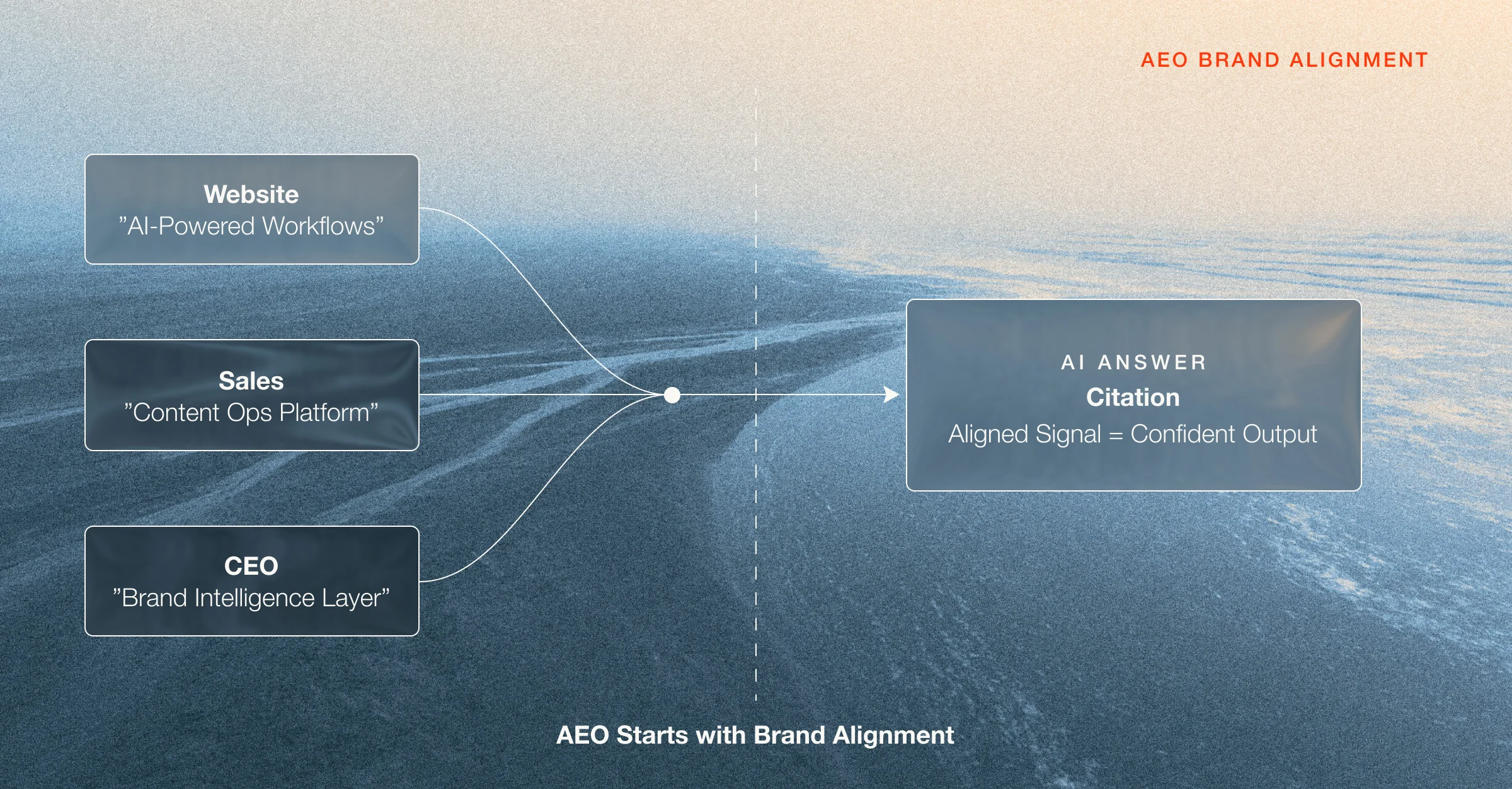
The website describes the product as a workflow automation tool. The sales team pitches it as a cost-reduction platform. The CEO calls it a collaboration OS in every podcast appearance.
All three descriptions are defensible. None of them are the same narrative. From the model’s perspective — reading all three sources simultaneously — they look like three different products. When a buyer asks which workflow automation tools to evaluate, the model doesn’t have enough confidence in this brand’s category to include it. Fragmented descriptions split your entity and weaken recognition everywhere.
Does AI pick the brand before it picks the source?
Seer Interactive published research in 2026 testing how models actually assemble a recommendation. Across six behavioral tests spanning 362,188 responses, one pattern held: the model settles on which brands to recommend first, drawing on what it already knows. Then it goes looking for sources that support those choices.
The citation is the bibliography. The decision came earlier.
That sequence is the whole problem. Citation optimization can’t overcome weak brand recognition, because the recommendation was already made by the time citation logic runs. If the model’s picture of you is fragmented, you were skipped upstream of anything your tooling can measure.
Seer’s companion finding sharpens it. One client’s page earned more than 100 citations in 25 days without the brand ever being named once. Perfect retrieval. Zero recognition.
One client’s page earned more than 100 citations in 25 days without the brand ever being named once.
That pattern traces back to the same root cause. Different people inside the company have different ideas about what the company actually is, and the content that flows out reflects those differences.
No amount of technical optimization closes it.
Why can’t AEO tools detect this?
AEO platforms measure the symptom well: your brand isn’t appearing in answers where it should. Most also give sound tactical guidance — improve content structure, build schema markup, earn co-citations. All of it assumes the underlying brand signal is coherent.
Ahrefs’ analysis of 75,000 brands found that off-site brand signals correlate with AI visibility about three times more strongly than backlinks: branded web mentions at 0.664 against 0.218 for backlinks, with branded anchors at 0.527. What the model has absorbed about your brand from everywhere else outweighs what you’ve structured on your own site.
The industry treats that as an external cleanup job. Update the directories, fix the schema, match your name across platforms. Useful maintenance, and it leaves the cause untouched, because those external signals are produced internally. Sales writes from the conversations they’re having. Product writes from what they’re shipping. The CEO tells the story of the company they’re building. Each version is accurate. None of them were coordinated.
You can’t schema-markup your way out of internal misalignment.
How do you check whether your messaging is aligned?
Twenty minutes, no tooling. Open a blank doc, make five rows, and paste one sentence into each.
- Website. The first sentence of your homepage hero. Not the tagline — the sentence that says what the product is.
- LinkedIn company page. The first sentence of the About section.
- Founder’s LinkedIn. The headline, plus the opening line of their most recent post about the company.
- Review profile. Your G2 or Capterra description, and the category you’re listed under.
- Sales. The first content slide of the deck your AEs actually send, not the one in the brand folder.
Then answer two questions.
How many categories appear? Write down the noun each row uses for the thing you sell. Workflow automation tool. Cost-reduction platform. Collaboration OS. Count the distinct nouns.
How many audiences appear? Same pass, for who it’s for. Ops leads. CFOs. Product teams.
One noun and one audience across all five rows means your entity is clean, and a citation problem really is a tooling problem — go optimize. Two nouns means the model is splitting you across two categories and is confident in neither. Three or more and you are the fragmented brand in the example above.
The row that wins is the one your CEO will keep saying. Marketing’s preferred sentence loses to the founder’s actual sentence every time, because the founder’s version is the one that ends up in podcasts, press, and posts — which is most of what the model reads. Pick it with sales, product, and the founder in the room, then rewrite the four rows that disagree.
Where do B2B buyers start vendor research now?
G2’s March 2026 survey of 1,076 B2B buyers found that 51% now begin their purchasing process in an AI chatbot rather than a search engine. Of those buyers, 69% chose a different vendor than they’d originally planned based on AI chatbot guidance. One in three bought from a vendor they’d never heard of before.
The shortlist is being assembled in a system most marketing teams have zero visibility into. The brands that appear on it aren’t necessarily the ones with the most optimized content infrastructure. They’re the ones the model can confidently describe.
A thin review presence or a poor category position doesn’t just cost you buyer credibility. It gives AI chatbots less to be confident about — which makes them less likely to recommend you over another brand.
How do you align messaging before optimizing for AI?
The sequence matters. Before you optimize for AI citation, the people producing content that represents your brand need to be telling the same story. Resolving the positioning internally is the actual work, and a messaging document in Notion doesn’t get you there. It has to show up in how your team writes, speaks, and describes what you do.
Here’s the operational version of that. Most teams try to hold consistency through review — someone senior reads everything before it ships and catches the drift. That works until volume outpaces the reviewer, which at growth stage takes about a quarter. The alternative is to encode the positioning and the voice once, at the source, so it’s carried into every output by default: the blog, the founder’s LinkedIn, the sales one-pager, the draft an LLM returns when someone on your team prompts it. One signal, produced from rather than corrected toward.
That’s what makes the external picture converge. The entity the model builds from your LinkedIn, your website, your press, and your third-party mentions starts to look like one clear thing. That clarity is what gets cited.
AEO tooling has a real role — citation tracking, schema markup, structured content. But those levers work on the assumption that the underlying brand signal is consistent. When it isn’t, they’re measuring a symptom.
Alignment first. Then optimization.
FAQs
Does brand alignment actually affect whether I get cited by AI?
Yes. LLMs build entity models from all available signals. Inconsistent messaging across those sources produces a fragmented entity representation. Fragmented entities get cited less often and less confidently — even when your content quality is high.
Can’t I fix this with better schema markup or AEO tooling?
Schema markup and AEO tools optimize the outputs — the content that reaches the model. But if the underlying messages conflict, you’re optimizing signals that contradict each other. Technical work compounds when the brand signal is clean. It doesn’t substitute for alignment.
What counts as “inconsistency” in this context?
Not typos or logo mismatches. The meaningful inconsistencies are messaging ones: different descriptions of what your product does, different framings of who it’s for, and different articulations of the value — across your website, your team’s LinkedIn, your press, and your reviews. When these don’t cohere, the model’s picture of you doesn’t cohere.
How long does it take to see citation improvement after fixing alignment?
AEO practitioners typically note 6–12 months for consistent citation improvement. Aligning internal messaging shortens the iteration cycle by ensuring all new content reinforces one coherent entity signal from the start — rather than adding more noise to an already fragmented picture.
Isn’t AEO just SEO with a different name?
Partially. The underlying authority signals overlap significantly. But citation requires entity recognition and confidence, not just topical relevance. That’s what makes internal alignment a prerequisite, not just a nice-to-have.
If alignment is the fix, what does fixing it actually involve?
Two things. Getting the leadership team to one agreed narrative, then encoding that narrative somewhere it can be applied consistently rather than remembered inconsistently. The common failure mode is treating it as a document. Positioning that lives in a file gets read once. Positioning that’s encoded into how your team drafts — including how they prompt AI tools — shows up in every output, which is what the model reads.
